

Linear Clock (MVMT 113) : 13 Steps (with Pictures) - whisleroulty1966
Introduction: Elongate Clock (MVMT 113)
No matter what Deepak Chopra tells you, clock time is linear. Hopefully this clock is a little closer to reality than the circular ones we're entirely used to. The five minute intervals tone less neurotic than being precise down to the moment, and each number is magnified, reminding you to focalize on the present.
I made this using just about every simple machine at Pier 9 (waterjet, sand chargeman, optical maser cutter, 3D printer, electronics lab, etc.). It's made of 6061 aluminum, steel hardware (screws, nuts, bearings), 3D printed gears, an Arduino Uno, and the hour and minute panels are laser dilute / etched plyboard.
Of course I know this project isn't accessible to almost everyone who doesn't have the insanely luckiness of having access to a shop like this, but hopefully you'll find it inspiring.
Spinal fusion 360 is on the loose for students and hobbyists, and there's a long ton of learning support happening it. If you deprivation to learn to 3D model the kind of work I do, I retrieve this is the best choice connected the grocery store. Get across the links below to bless sprouted:
Student/Educator
Hobbyist/Inauguration
I also led a series of webinar classes related to 3D moulding projects with moving parts. In these webinars, you will learn Coalition 360 features like advanced mechanistic assemblies (significance two or more joints interacting) and rendering. The last webinar focused on modeling this clock design in Fusion 360. You can watch the total video here:
If you're interested, sound out the other ii webinars in that series where you will instruct to invention a Giant Knob Lamp and a Perpetual Clock with Arduino.
Step 1: 507 Mechanical Movements
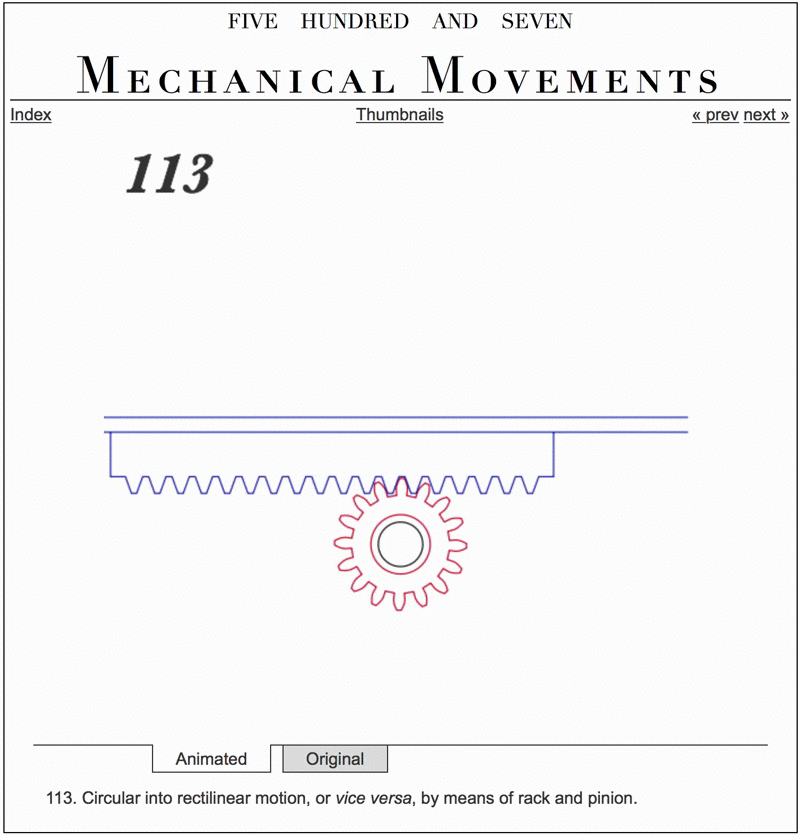
507 Mechanical Movements is an encyclopedia of vernacular mechanisms from the 1860's that serves equally a good reference for this rather affair. This chemical mechanism is bases on Movement 113, "Rack and Quill".This is departure to be a long project, then if you've got a specific chemical mechanism you'd like ME to make, feel free to make a bespeak in the comments!
Step 2: Design & 3D Model
The video supra is a recording of a webinar I did for the rack and flight feather invention part of the project.
The hardest part of the design to work out was the extort and pinion appurtenance assembly. The math for gear blueprint can make pretty complicated (in fact, there are engineers WHO basically only design gear assemblies for this very reason), simply supported a great Youtube tutorial away Rob Duarte, I made my own template that works with the in style version of the Spur Gear add-in for Merger.
The picture above walks you through the process of qualification the rack and pinion assembly, but if you require a many thoroughgoing tutorial, please join me for the Design Straightaway Hour Of Fashioning in Apparent movement webinar on Apr 5. If you pretermit the webinar, IT'll be recorded and I'll post the TV here.

The template (link below) has whol of the parameters shown above already entered. I won't move in the math Here, but if you adopt the instructions, IT should work for you.

Habituate the Spur wheel tote up-in by going to ADD-INS > Scripts and Add-Ins... > Spur Appurtenance > Run. When you get the windowpane shown above, enter the parameters. Number of Teeth won't let you wont a parametric quantity for the value, soh just wee-wee sure it matches the teethNum value if you change it. You also ingest to multiply the named parameters past 1 as shown in a higher place.
Keep in mind that once the gear is ready-made, you can edit it just comparable whatsoever other object in Fusion.

As shown in the video demo, this is an object lesson of how you'd construct a tooth profile using the parameters.
Here are the golf links to the template you can use to make your own rack and pinion in Nuclear fusion:
Template with parameters:http://a360.cobalt/2oeT5El
After the rack and pinion geared wheel was patterned unstylish, I spent a lot of time modeling motors, switches, and early electronic parts, and then figuring out all the details. With the motion link described above, I was able-bodied to baffle a good picture of how it would look in apparent motion.
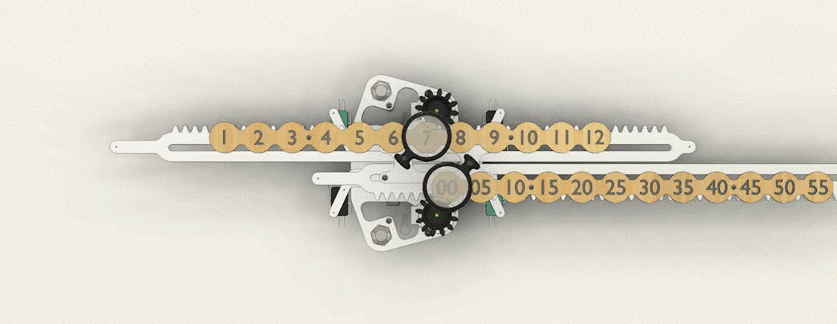
You crapper get at the file through the connectedness below, and dabble with it or even try to make your own version out of the file. There was quite moment of tinkering and alteration after the parts were made, so don't expect to be capable to righteous laser hack all the parts and have got a finished cartesian product. This project was expensive and took a spate of time! If you're really serious about fashioning it and call for any help, upright annotate below and I'll do my best to start out you going.
Finished Time Design: http://a360.co/2nk51nw
If you aren't already a Fusion 360 exploiter, sign up for my free 3D Printing Class. It's a crash programme in Optical fusion for making, and Moral 2 has whol the info you need to get Fusion for free.
Step 3: UPDATE 12/1/2020
Aft devising the first prototype I started o'er with some improvements to the blueprint. One of my colleagues from the Electronics team designed a usage circle to drive the motors, and on that point are magnetic sensors that assistant detect situation (indexed from magnets press-fit into the rails).
All of the components in the fashion mode have part numbers game, most are from McMaster Carr or DigiKey. This is a practically better design because it avoids the racking issue from the weight of the fulminate when fully extended, and because the attracter sensing element indexing ensures the proper position every time the motors move.
Complete Fusion 360 Gathering: https://a360.co/36ql7oK
Step 4: Hardware
- Panels: 6mm thick 6061 aluminum (presumably plyboard would work too)
- Count panel: 3mm plywood
- Arduino Uno: https://www.arduino.cc/en/Main/ArduinoBoardUno
- Adafruit Motor Shield: https://www.adafruit.com/products/1438
- 5V High stepper Motors: https://www.adafruit.com/products/858 ( I would commend using 12V motors instead of these )
- Confine switches (4): https://www.adafruit.com/products/818
- Momentary switches (2): https://www.adafruit.com/products/558
Step 5: Electronics & Scheduling
The electronics are all done with an Arduino Uno and an Adafruit Motive Buckler.
Here's the basic idea of how I lack it to exploit:
- When the unit of measurement is turned on, the steppers run the racks back until the limit switches on the left side are triggered. This sets the billet to nada. The steppers then run the racks forward until 1 is centered on the hour panel and 00 is concentrated on the minute panel.
- Once the hour and minute is concentrated, the racks move forward in sentence. A full position move on the bottom at stentorian speed every 5 minutes, and a full put up move on the top every hour.
- The momentary switches (pins 6-7) to move the racks presumptuous by one position (about 147 stairs), then continue with the time counting.
- The hour and small movements have counters that send the bars rearwards to the left limit switches and reset them to zero at one time hour has gone past 12, and the minutes have gone past 55.
I'm still not clear connected what exactly I need to do with the code. I've got it working in theory with the cypher below that got from Randofo. This code moves the minute bar forward one step every 200 MS (I think out) once uncomparable of the limit switches is triggered. IT works, but I'm jolly quickly out of my depth past tense the basic work I've done here. This seems like a beautiful easy problem for a savvy Arduino user, but I only if act a project with 1 maybe formerly a year, and every time I do, I've basically unnoticed everything I learned in the lastly imag.
<p>/*************************************************************</p> Efferent Shield Stepper Demo aside Randy Sarafan
For Sir Thomas More information see: <a href="https://web.instructables.com/id/Arduino-Motor-Shield-Instructor/"> https://www.instructables.com/Idaho/Arduino-Motor-Shi...</a>
*************************************************************/ #include <wire.h> #include <adafruit_motorshield.h> #include "utility/Adafruit_MS_PWMServoDriver.h"</adafruit_motorshield.h></cable.h>
// Create the motive cuticle aim with the default I2C address Adafruit_MotorShield AFMS = Adafruit_MotorShield(); // Or, create it with a different I2C address (say for stacking) // Adafruit_MotorShield AFMS = Adafruit_MotorShield(0x61);
// Link a stepper causative with 200 stairs per revolution (1.8 degree) // to motor port #2 (M3 and M4) Adafruit_StepperMotor *myMotor1 = AFMS.getStepper(300, 1); Adafruit_StepperMotor *myMotor2 = AFMS.getStepper(300, 2);
int delaylegnth = 7;
void setup() { //start serial connection Consecutive.begin(9600); //configure pin2 as an input and enable the intimate pull-up resistance pinMode(2, INPUT_PULLUP); // Serial.begin(9600); // set up Serial library at 9600 bits per second Asynchronous.println("Stepper test!"); AFMS.begin(); // make with the nonremittal frequency 1.6KHz //AFMS.begin(1000); // OR with a different relative frequency, say 1KHz myMotor1->setSpeed(100); // 10 rpm }
annul loop(){ //read the pushbutton rate into a unsettled int sensorVal = digitalRead(2); sensorVal == LOW; int delayL = 200; if (sensorVal == LOW) { Series.println("Minutes ++"); //myMotor1->abuse(1640, BACKWARD, DOUBLE); for (int i=0; i <= 10; i++){ myMotor1->step(147, BACKWARD, DOUBLE); //analogWrite(PWMpin, i); delay(delayL); } Serial.println("Hours ++"); myMotor1->step(1615, Frontward, Duplicate); //myMotor2->step(1600, BACKWARD, DOUBLE); myMotor2->pace(220, Nervy, DOUBLE); //delay(delayL); } other { //Serial.println("Equivocal spiral steps"); myMotor1->step(0, Forth, Three-fold); myMotor1->step(0, Retracted, DOUBLE); } } Footstep 6: Assemble the Base
The base is made of cardinal plates with spacers holding them together. The screws fasten to the plate through broached holes. Part number 6 on this drawing is another 3D written part- a spacer that's too a cradle for the power terminal for the stepper motors.
Step 7: Add Momentary Switches
The momentary switches, Arduino, and limit switches entirely fasten to the front plate, so accessing the electronics to make changes is easy- just take the rearward plate off and you can reach everything.
Step 8: Lend Mounting Plate and Limit Switches
The climbing plate holds the limit switches and the carriage assembly for the racks. This character can also stay together when editing the electronics.
Step 9: Add Stepper Motors & Gears
The high stepper motors fix to the board with M4 screws done threaded holes, and the 3D printed gears are weigh-fit onto the efferent posts. I used a gun trigger clinch to get them snug and flush.
Step 10: Add Racks
The racks have slots cut into them that brook on the two ball bearings. There's a small gap (.1mm) between the bearings and the slots, which allows the rack to act up freely.
The bearings are sandwiched between tailor-made 3D written spacers to gravel the perfect fit I needed. There's a rack crustal plate on the presence that acts As a automatic washer holding the racks in place.
Step 11: Add Time of day and Minute Parallel bars
The hour and minute bars fasten to the racks with 12mm spacers creating a gap that allows clearance between the bars and the racks.
Step 12: Add Magnifiers
The magnifiers are cheap pocket magnifying spectacles I ground on amazon. They'Ra offset from the front of the bars with 25mm spacers.
Step 13: Lessons Scholarly
I learned a lot about linear motion with this project. The tolerance I used between the bearings and slots connected the racks was a bit as well much, so if I were to make it once again I think I would probably cut information technology in half. The gap on the sides of the gaps was also a spot too sizable.
The motors work, merely the longer the cantilever gets, the more they have to work. I'd in all probability go with 12V steppers instead of 5V ones.
The backlash also should have been greater, maybe 0.25mm. The gears were bearing down on the racks too tightly with the first gears I tried.
Be the First to Share
Recommendations
Source: https://www.instructables.com/Perpetual-Clock-With-Arduino/
Posted by: whisleroulty1966.blogspot.com
0 Response to "Linear Clock (MVMT 113) : 13 Steps (with Pictures) - whisleroulty1966"
Post a Comment